What is freestyle snowboarding?
See other riders getting some air? Wondering what rails and jibs are? We’ve got you covered with our one-stop guide to what is freestyle snowboarding and the basics of riding in the park.

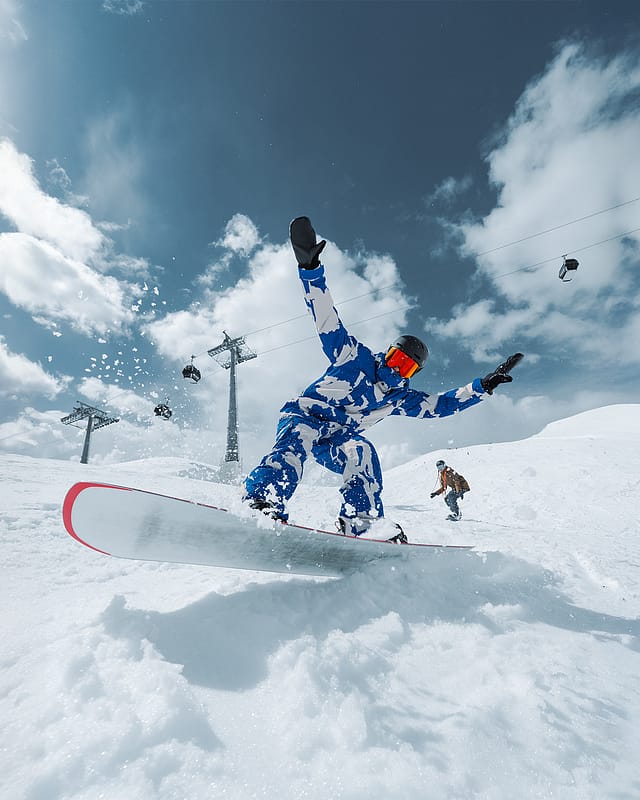
Okay, let’s cut to the chase: Freestyle is a style of snowboarding involving tricks, spins, and air time off man-made obstacles and natural features (but we’re spoiling what’s to come).
“What snowboard can I use?” you might ask. “I watched Big Air in the Olympics, and that’s freestyle, right?” All valid questions. And we’ve got the answers right here. So, drop in to our quick guide and brag about your newfound knowledge at après.
Riding styles
Freestyle snowboarders include the regular Joes (and Josephines!) who happily laps the park all day, Dope Snow athlete Moritz Boll, who stomps sunset sessions in LAAX, and Chloe Kim, who dominates in the halfpipe. Yep, freestyle snowboarding breaks down into a fair few disciplines, especially on the competition circuit. So, let’s take a look at what’s what.
Jibbing
Ask most riders what they think of when imagining freestyle, and most will say jibbing. This simply encapsulates doing any tricks (big or small) anywhere on the mountain. From buttering on the side of the slope to spinning onto a rail in the park, and even nose pressing onto a log (don’t knock it until you try it!). It’s all jibbing!
Slopestyle
Slopestyle is riding a purpose-built course with different features, including rails and kickers. Like a terrain park, riders choose their own lines. However, unlike a terrain park, slopestyle is typically practiced only in competition (such as X Games), with points awarded for creativity, amplitude, and execution. Slopestyle made its Winter Olympic discipline that debuted at the Sochi 2014 Games.
Halfpipe
A halfpipe is typically a 22-foot (6.7-meter) U-shaped course where snowboarders ride from one huge wall to the other, catching air off the lips and performing tricks with grabs. Snowboarding halfpipe is also an Olympic discipline, and made its first appearance at the 1998 Nagano Winter Games in Japan.
Big Air
Big Air is kind of exactly what it sounds like. It’s a huge man-made kicker designed for riders to score mega air and perform grabs, corks, and insane rotations. Snowboard Big Air is part of the Olympics and was introduced at the 2018 Winter Olympics in PyeongChang, South Korea.
Snowboard cross/boardercross
Snowboard cross (also known as boardercross) involves four to six snowboarders racing down a course that typically features rollers, jumps, obstacles, and tight turns. It’s also an Olympic discipline, and was first introduced at the 2006 Winter Olympics in Turin, Italy.
Rail jams
Rail jams are creative grassroots events held at terrain parks and dry slopes across the world. These mellow sessions involve riders performing tricks on rails, boxes, and other features. We don’t wanna brag, but our Dope Snow rail jams are pretty legendary.
Terrain
Freestyle snowboarding can pretty much be done anywhere on the mountain. From sidehits on trails to natural features in the backcountry. However, there’s no doubt that the best place for it is the terrain park.
Parks are specifically designed for freestylers, with features built to test skills and boost progression. That could be launching off a kicker, sliding rails and boxes, or jibbing a more unique obstacle like a bonk feature! This ultimately makes freestyle different from freeriding, which involves getting creative on natural, often ungroomed terrain, rather than anything man-made.
Tricks and techniques
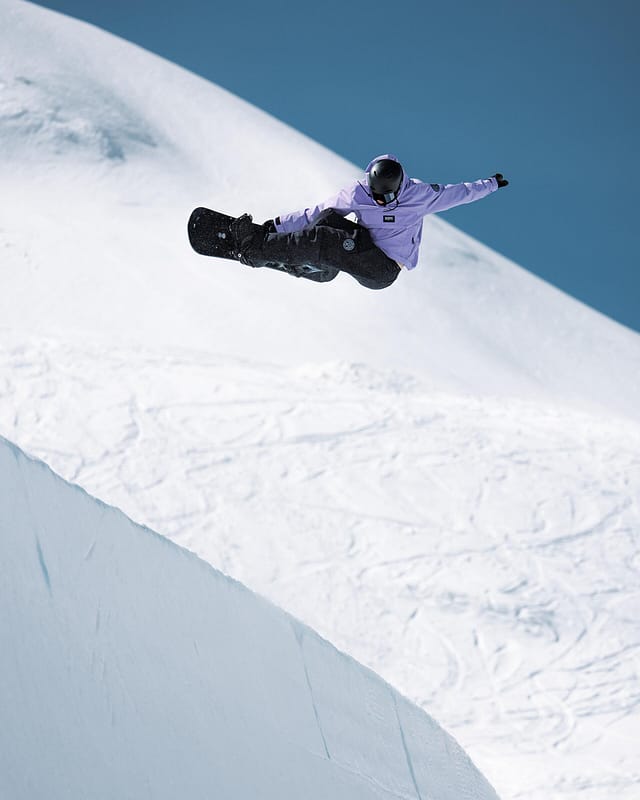
Typically, freestyle tricks fall into four categories: butter tricks, grabs, spins, flips and corks, and rails and boxes. Butter tricks such as ollies, nose presses, and tripods are fantastic starting points and require zero airtime. Grabs, on the other hand, are the backbone of snowboarding tricks and involve grabbing onto your board mid-air with one hand or two. Spin, flips, and corks are where things get a little more complex (and provide a little more airtime).
Spins involve rotation around the vertical axis and build in increments of 180 degrees (for example, from 180 up to 1620+ when landing switch, and 360 up to 1800+ when landing forwards). Flips rotate around a horizontal axis and include tricks such as rodeos, wildcats, and more. Corks are off‑axis spins that mix both. Lastly, rails and boxes give ya an alternative if air and flatland tricks aren’t your thing. 50-50s, backside boardslides, and bluntslides are all examples of super-fun grinds on rails and boxes. Want some inspiration for your freestyle snowboarding journey? Check out our freestyle snowboard tutorials on YouTube, like the one below.
Freestyle snowboard designs
What’s attached to your feet is hugely important when catching air or finally nailing that backside boardslide. That’s why many freestyle snowboards are true twins, meaning the nose and tail of the board are the same shape and size, though their flex profiles (cambered, rocker, or hybrid) and constructions can vary.
With this combination, freestyle snowboards are easier to land switch (backward) on takeoffs and landings. The identical length nose and tail makes rotations easier and more predictable, and depending on the camber profile, it can change how the board responds to the snow. Cambered boards will feel plugged in with sharp edges and lots of pop (but little forgiveness), while rockered boards will feel looser and more surfy but less stable.
Wrapping up
Well, there you have it. Freestyle boils down to throwing down tricks. And it can be done almost anywhere. Sure, the park is a good starting point. But, you can also show off what you’ve got on groomers, the backcountry, and even the streets (what else are handrails for, right?).
Speaking of showing off, why not give us a glimpse of your riding style by joining our Dope Snow Community Facebook Group? It’s full of stylish, like-minded riders alongside Dope Snow crew, ready to fill your feed with rail jam info, collection updates, meetups, and even one or two giveaways.
Related reading: